The Real World of Investments
Rethinking Portfolio Management in the Digital Age
By Egor Gizatullin
For decades, investing followed a simple rule: entrust your capital to a bank and let professionals navigate the markets. Institutions promised to identify opportunities, anticipate trends and outperform benchmarks, while investors remained largely passive.
Today, this model is being quietly reshaped. The rise of digital platforms, real-time information and low-cost trading has fundamentally altered the relationship between investors and financial institutions. What was once reserved for professionals is now accessible to anyone with a smartphone.

Where history meets the rhythm of the modern city

London at dusk: tradition illuminated by modern life
The Rise of Passive Investing
The rapid growth of exchange-traded funds reflects this shift. Rather than attempting to outperform the market, ETFs replicate it, offering diversified exposure at minimal cost. For many investors, this simplicity has become more appealing than complex strategies with uncertain outcomes.
As a result, passive investing has gained significant ground. Increasingly, investors question whether active management justifies its fees, especially when consistent outperformance remains difficult. Lower costs and transparency have become decisive factors in portfolio construction.
With these tools now widely available, building a diversified portfolio is no longer as complex as it once was. A core allocation to broad market indices can provide exposure to global economic growth. Complementary assets — such as precious metals or digital currencies — introduce additional dimensions of diversification, reflecting both traditional hedging strategies and emerging financial infrastructures.

A dialogue between heritage and modernity
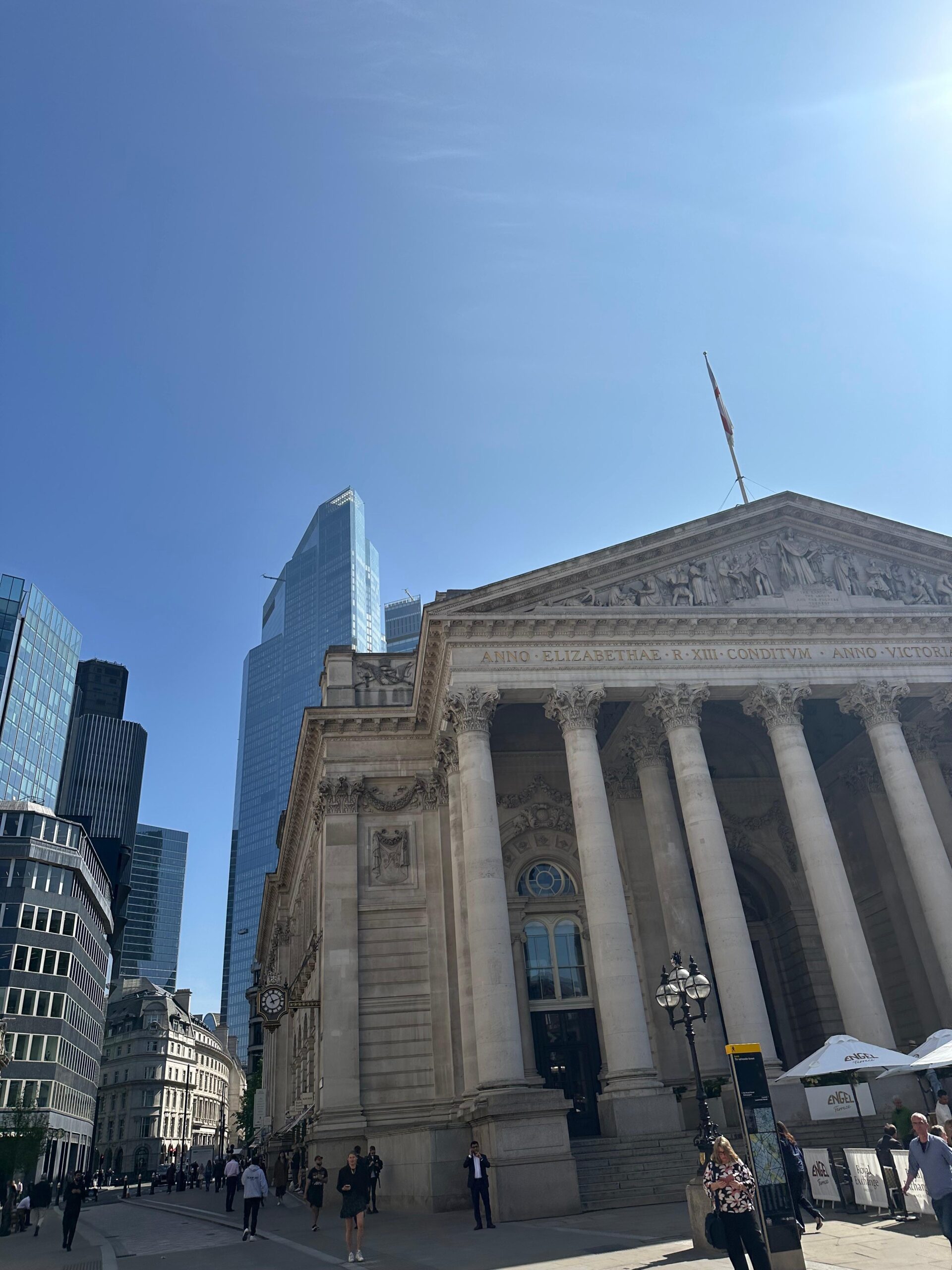
Finance through time: from classical columns to glass towers
The Appeal of Alternative Investments
At the same time, a parallel transformation is unfolding in alternative investments. Unlike public equities, these assets — ranging from private equity and credit to real estate and tangible assets — operate within less liquid and more complex environments. Their appeal lies in diversification and the potential for differentiated returns, particularly in markets where public assets have become increasingly efficient.
However, access to these opportunities remains limited. Higher capital requirements, operational complexity and regulatory constraints create barriers for individual investors. Managing such assets requires specialized expertise, infrastructure and long-term commitment.
This contrast highlights a structural evolution in portfolio management. While public markets are becoming increasingly democratized, alternative investments remain largely within the domain of institutional players.

A city shaped by centuries of commerce

The modern workplace at the heart of global finance
The Transformation of Asset Management
In this context, the role of asset managers is shifting. Rather than competing with efficient public markets, their value increasingly lies in providing access to more complex and less accessible investment strategies. Expertise, sourcing capabilities and operational infrastructure become the key differentiators.
What emerges is not the disappearance of professional management, but its transformation. Investors can now independently manage a significant portion of their liquid portfolios through simple, transparent instruments. At the same time, institutions may focus on areas where genuine expertise and access continue to create value.
The future of investing may therefore rest on a new balance: individuals taking greater control of liquid assets, while professional managers specialize in navigating the complexities of private markets.
In the long run, this division could define the next chapter of modern portfolio management.
Where history frames the flow of modern capital