Valeria Morgun is a Paris-based contemporary artist whose work moves effortlessly between intimacy and iconography. Drawing from centuries of art history while remaining acutely rooted in the present, she constructs visual narratives layered with symbols, quiet provocations, and deeply personal meaning.
Her paintings are visually arresting, yet their true power lies beneath the surface. Each work becomes a meditation on existence, identity, and the divine — not as distant concepts, but as lived, bodily experiences. By weaving classical references into a distinctly contemporary sensibility, Morgun opens a conversation about femininity, resilience, and the spiritual undercurrents of modern life.
The Artist as Motif
The artist herself is her primary motif. She appears again and again, moving from canvas to canvas, not as a fixed portrait but as a shifting presence. Morgun does not draw a line between life and art; her latest series orbits her inner world — her emotional states, anxieties, memories. Childhood impressions, reflections on femininity and divinity, the physicality of the body, and the anticipation of motherhood all surface organically.
It is unapologetically personal, even deliberately self-centered — and therein lies its honesty.
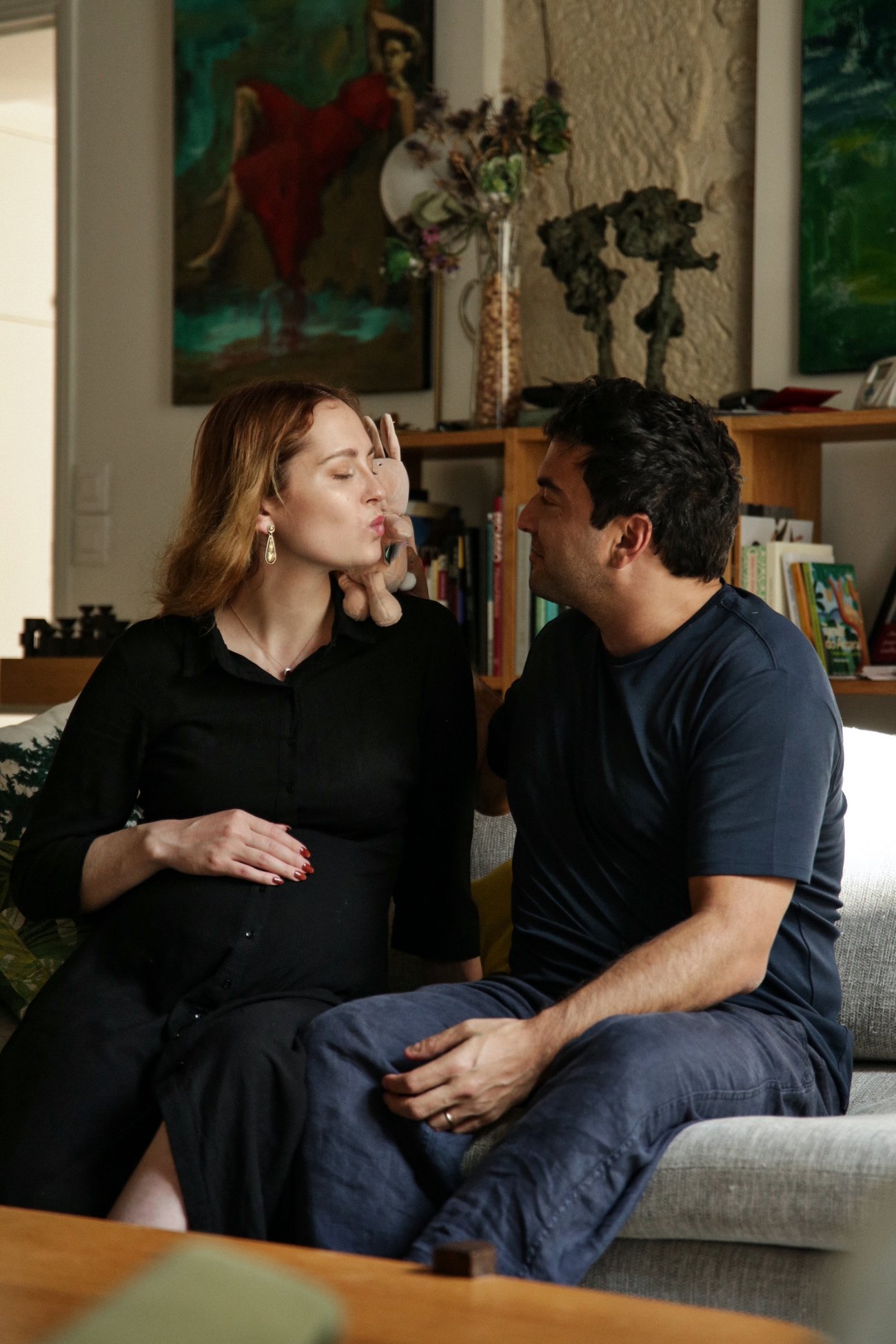
Valeria Morgun with her partner
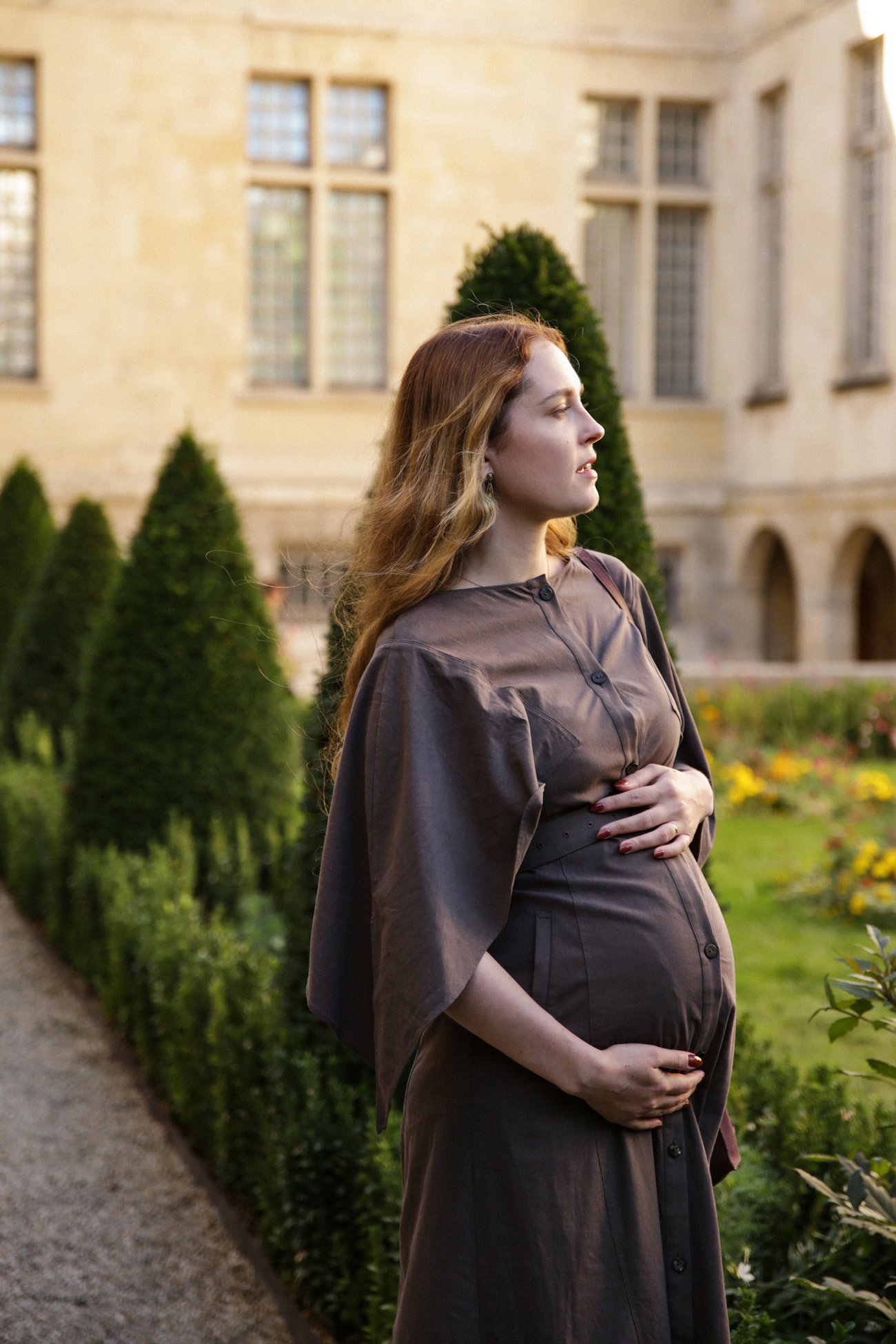
Valeria Morgun in a contemplative moment
Madonna with Placenta
One of the most striking works in the series, Madonna with Placenta, captures a moment rarely addressed with such directness: fertility as both sacred and biological. At first glance, the composition echoes the visual language of classical religious icons. Yet something feels subtly wrong, or rather — deliberately disrupted. The work both venerates creation and confronts the uneasy, often silenced realities of female embodiment.
Here, the Madonna does not cradle an infant, but a placenta. An organ formed entirely by the female body — the only temporary organ a human being ever creates. It sustains life, protects it, and makes its emergence possible. This choice is neither shock for shock’s sake nor pure symbolism; it is an act of radical honesty, where scientific fact and artistic reinterpretation converge.
Inevitably, the question arises: did Mary have a placenta? If her conception was miraculous, if the birth itself was immaculate, where does the line between miracle and biology truly lie?
At this point, Morgun’s work transcends the boundaries of art, entering a space where philosophy, theology, and biology overlap — and quietly collide.
The Body, Still Uncharted
Even today, pregnancy remains surrounded by taboo. Many of its realities are still underrepresented, unspoken, unseen. Medical research has long privileged the male body; only in recent decades have medications begun to be systematically tested on women. Even common painkillers were, for years, studied primarily through male subjects.
The female body — more complex, more variable, more responsive — remains insufficiently understood.
Valeria Morgun outdoors