Victoria Aleksa is the founder of Aleksa Advisory, an independent art advisory based in Paris. Between strategy, sensitivity and human accompaniment, she shares her vision of the profession and the international art market.
1. Your path to becoming an art advisor
I always dreamed of building something in the business world — much like my mother — while knowing I had a deep sensitivity to art. That is why I first studied project management in Saint Petersburg, before pursuing studies in the art market in Paris. My early professional experiences at Christie’s, kreo and Perrotin gave me a concrete understanding of how the art market works and helped me realise how much I loved guiding collectors through acquisitions and sales.
In 2022, I founded Aleksa Advisory, an independent art advisory that embodies everything essential to me: structure, strategy, creativity, sensitivity to art, intuition, the human dimension and freedom.
2. An international practice
Every art market is a unique ecosystem, shaped by its cultural, political, economic and institutional context. The French market, for example, is more structured and predictable, while the Russian scene is more emerging and often requires greater contextualisation. I adapt my approach to each environment, maintaining a high level of transparency about the maturity and visibility of each market.
3. The main challenges of advisory work
One of the greatest challenges of being an art advisor is maintaining a strong and trustworthy network. Access to previews, major works or rare pieces is never automatic — it is built over time, through long-term relationships. Another challenge lies in navigating a market that is not always transparent, and in guiding collectors toward sound, informed decisions, especially in demanding contexts such as art fairs.
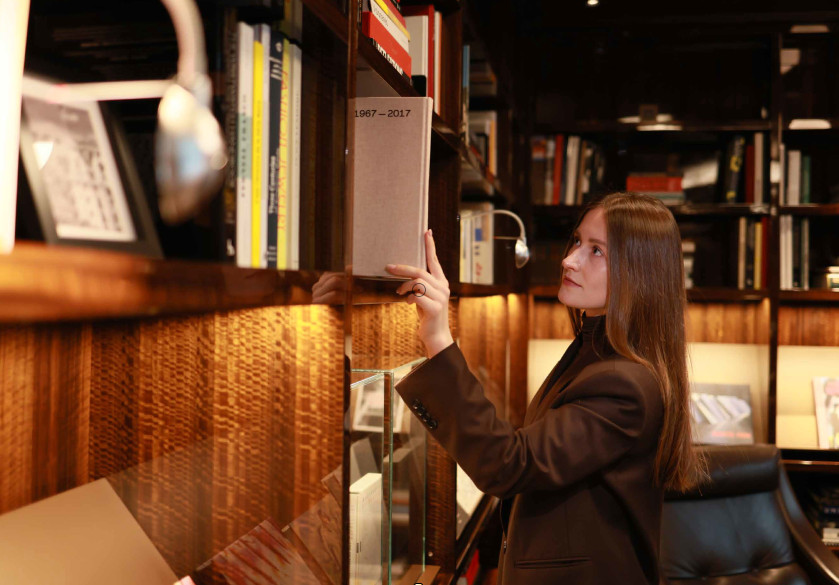
Victoria Aleksa during a moment of research
4. Visiting a fair: Art Paris, Art Basel
At fairs, I try to see as much as possible, because discovery often happens where you least expect it. When it comes to new talents, a certain je ne sais quoi is essential — alongside a distinctive visual language and a broader context: the gallery’s positioning, the consistency of the work and the artist’s trajectory.
5. Art Paris in the international landscape
Art Paris has a distinct identity: while maintaining an international dimension, the fair is deeply rooted in the French art scene and offers a more eclectic and exploratory approach than major international fairs like Art Basel, often giving visibility to less established artists.
6. Passion and investment
My starting point is always the collector’s taste, and my role is to identify strong works with investment potential within their aesthetic universe. There is no strict boundary between passion and investment.
I try to align emotion with solid artistic foundations and market fundamentals, so that the collection remains both meaningful and sustainable over time.
7. Fairs, galleries and digital platforms
Today, art fairs play a hybrid role: they are commercial platforms, but also increasingly curatorial and digital spaces. They allow collectors to compare many galleries and artists in a short amount of time. As for Art Paris, its importance has grown considerably in recent years, through curatorial projects, dedicated sectors, monographic exhibitions, prizes and a VIP programme deployed across the city.
8. Building long-term relationships
Long-term relationships are built on consistency, transparency, independent thinking and personalised support. Collectors trust art advisors who have a clear point of view, who are honest about works and their contexts, and who are genuinely committed over time.
Trust is built when advice is guided by integrity, not by the sale.
9. Advice for new collectors
I would encourage new collectors to be curious and to ask questions. Engaging with galleries is part of the experience and helps develop a better understanding of artists, contexts and approaches. There is no obligation to buy the first work that appeals to you immediately — fairs are above all spaces for comparison and discovery. Take the time to see as much as possible, ask for additional information and make considered decisions when acquiring works.
10. The future of the art advisor
As the art world becomes increasingly complex, international and fast-moving, the role of the art advisor will become even more central. Art advisors will act as filters and long-term partners, helping collectors navigate the flow of information, build coherent collections and make responsible choices.